Ask ten homeowners what the number next to the temperature on their weather app means and you'll get ten shrugs. I know, because I ask. It comes up in most of the attics I work in, and the answer is almost always some version of "higher is worse, right?"
They're right, as far as it goes. That number is the Air Quality Index, it runs from 0 to 500, and it scores how much health risk is riding on the outdoor air at that moment. Lower means cleaner. Higher means the air outside stands a better chance of bothering somebody's lungs or heart before dinner.
Trouble is, "higher is worse" leaves out the parts that would actually help you. What follows is the AQI meaning the way I'd explain it standing in your driveway, using comparisons you already trust for other things. One thing worth knowing up front: the U.S. runs its own version of this scale, and other countries run their own air quality indices with different ranges and category names, so a reading you catch on a trip abroad won't line up with the one at home.
And here's where I'm coming from. I spend my working life in attics, which sounds like an odd place to care about outdoor air, right up until you've knelt on a joist and watched daylight come through the gap around a hatch.
TL;DR Quick Answers
AQI Meaning
AQI stands for Air Quality Index, a 0 to 500 score reporting how much health risk today's outdoor air carries. Lower is cleaner. Only the single worst pollutant sets the number, and because outdoor air leaks into your house, that reading doubles as an early warning for the air indoors.
Short for Air Quality Index. A 0 to 500 scale, where lower means cleaner air.
Outdoor air only. Nobody publishes an AQI for your living room.
100 is the hinge. At or below is generally satisfactory. Above it, sensitive groups feel it first.
The worst pollutant wins. The number reflects the highest-scoring pollutant that day, not an average of the six tracked.
Top Takeaways
AQI runs 0 to 500 and scores outdoor air pollution health risk, not a percentage of pollution.
Lower means cleaner. At or below 100 is generally satisfactory, and above 100 turns unhealthy for sensitive groups first.
Six color-coded categories run green through maroon, and each one is an instruction rather than a math result.
Only the single worst pollutant of the day sets the score you see.
AQI measures outdoor air, but that air reaches your indoor air through gaps in the building envelope, and the attic is usually the largest one.
What AQI Actually Measures
AQI scores health risk rather than counting how much dirt is floating around, and that distinction changes what you do with the number.
Think about the UV index for a second. When the forecast says UV 8, nobody hears "the sun is 8 percent out." You hear "burn time is short today, grab a hat." AQI works the same way. It takes pollutant concentrations and boils them down to one risk score, so you never have to know what 35 micrograms per cubic meter feels like.
The misread I run into most is that AQI 100 means the air is 100 percent polluted. It doesn't. An AQI of 100 lines up roughly with the short-term national health standard for whichever pollutant is running worst that day, which is why anything at or below 100 gets treated as satisfactory. Push past it and the air starts causing trouble, first for people who are already sensitive, then for everybody as the number climbs.
Six pollutants feed the index: ground-level ozone, fine particles, coarse particles, carbon monoxide, sulfur dioxide, and nitrogen dioxide, which is why high quality filters can matter for managing some of the particles that make their way indoors.
The 0 to 500 Air Quality Index Meaning, Category by Category
Six categories cover the whole range, and every one carries a color.
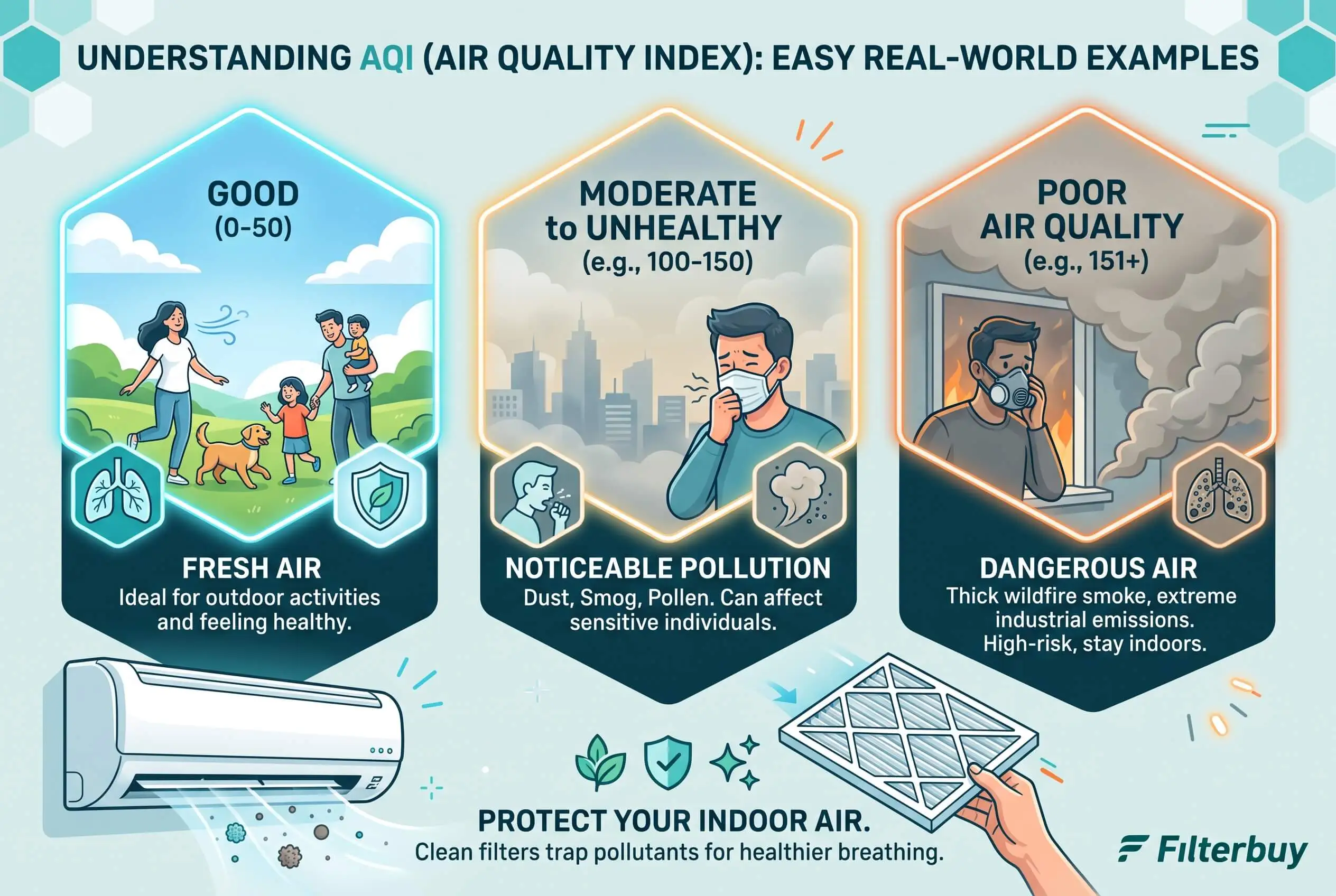
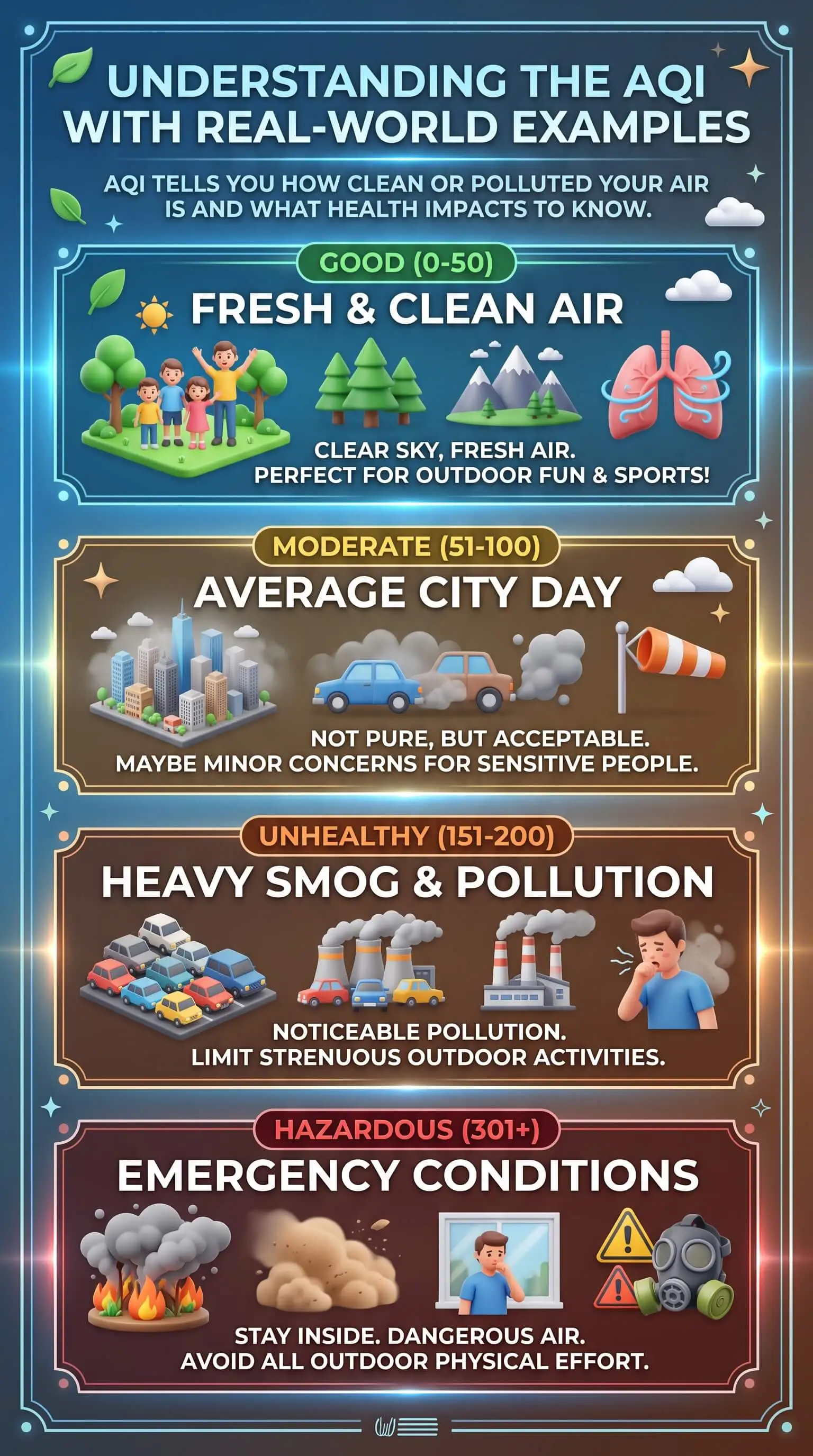
0 to 50, green, Good. Go about your day.
51 to 100, yellow, Moderate. Fine for almost everybody, though a small number of unusually sensitive people may notice something.
101 to 150, orange, Unhealthy for Sensitive Groups. Kids, older adults, and anybody with a heart or lung condition should ease off long stretches of hard outdoor work or play.
151 to 200, red, Unhealthy. Everybody cuts back.
201 to 300, purple, Very Unhealthy. Move what you can indoors.
301 and up, maroon, Hazardous. Emergency conditions.
The comparison I use with homeowners is a swimming forecast at the beach. Green is calm water. Yellow is calm water with a note that weak swimmers should pay attention, orange means the strongest swimmers are fine while everybody else shortens the session, and red is the lifeguard waving people in. Nobody stands on the sand arguing whether red is twice as bad as orange, because these categories are instructions, not arithmetic.
For the full breakdown of aqi meaning, including what each AQI number actually means and what to change around the house at each level, it's worth keeping something on your phone for the days the number moves.
Why the Worst Pollutant Sets the Whole Score
Here's the piece most explanations skip, and it's the one that makes the number finally click.
Every pollutant gets scored on its own. The AQI you see reported is whichever one came back highest, which means it isn't an average or a blend of the six. It's the single worst performer of the day, standing in for all of them.
It works like a report card that only prints your lowest grade, so five B pluses and one D still reads as a D.
Say ozone comes in at 58, fine particles at 121, and carbon monoxide at 14. Your reported AQI is 121. Particles win, and the other two never appear anywhere on your screen.
That's also why forecasters name the pollutant right next to the number, and federal reporting rules require them to. The detail matters more than it sounds. Ozone peaks on hot sunny afternoons and eases off after sundown, while particle pollution from smoke can park over a town for days. Same number on the app, completely different plan for your evening, especially when you're also thinking about how attic insulation affects the air getting into your home.
Why an Outdoor Number Shows Up Inside Your House
AQI is an outdoor measurement. There's no AQI for your living room, and nobody publishes one for your address.
Even so, that outdoor number is the best early warning most families have about their indoor air, because outdoor air doesn't stay outside. It comes in through open windows and doors, through the ventilation system, and through every gap, joint, and seam in the shell of the house.
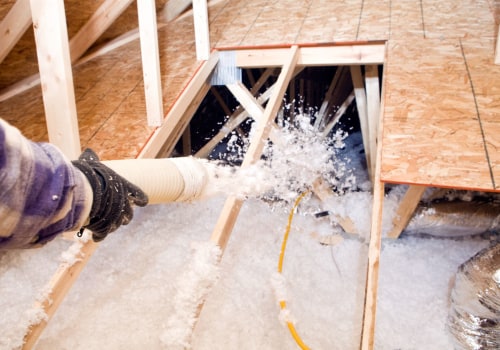
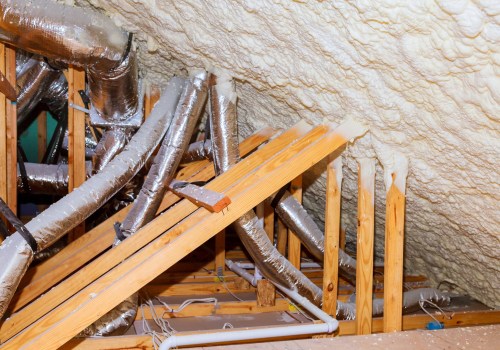
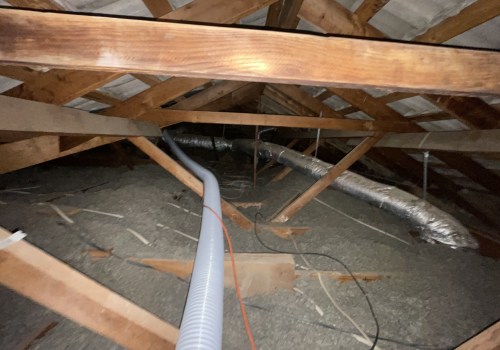
In most of the homes I walk, the biggest of those gaps are over your head. Unsealed top plates where interior walls meet the attic. Recessed can lights nobody ever gasketed. The open chase around a plumbing stack, and a pull-down hatch showing a quarter inch of daylight around the whole perimeter. Homeowners picture the attic as the place heat sneaks in during August, and they're right, but it's the same pathway on a smoky day running on the same physics.
I've stood in second-floor bedrooms that smelled faintly of smoke a couple of hours after a bad-air afternoon while the downstairs smelled like nothing at all. That's not imagination. That's the stack effect pulling attic air down into the living space. If you've never checked, the signs of a poorly sealed attic are usually visible from the hatch without going in.
So the honest version of the answer goes like this. Outside is where somebody measures the number. Inside is where you live with whatever's left of it, which is why issues like air duct repair can matter when outdoor pollution is making its way indoors.
What to Actually Do at Each Level
Green and yellow, 0 to 100. Normal routine. Check that your filter's on schedule so it's clean and ready when conditions turn.
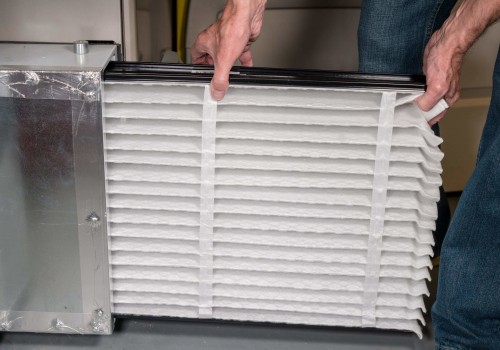
Orange and red, 101 to 200. Close the windows and run the system fan or the recirculation setting. Then pull the filter and look at it, because a loaded filter can't move air the way a clean one does.
Purple and maroon, 201 and up. Stay in as much as you can and cut the indoor sources too, which means no candles, no frying, no wood burning. Run the best filtration your system is rated for.
One more thing worth saying plainly, since it's the part I get asked about after the smoke clears. Better filtration also cuts down the allergens already circulating inside, which is a separate problem from outdoor smoke and shows up on the very same filter. And for anything touching your own breathing, asthma, COPD, or a heart condition, talk to a healthcare professional instead of taking a home-services opinion for it.
A Plain-English Glossary
AQI. Air Quality Index. A 0 to 500 score for outdoor air pollution health risk.
PM2.5. Fine particles 2.5 micrometers across or smaller, small enough to travel deep into your lungs.
PM10. Coarser stuff like dust and pollen.
Ground-level ozone. The main ingredient in smog. It forms when sunlight reacts with vehicle and industrial emissions.
Breakpoint. The concentration where the AQI tips from one category into the next.
Sensitive groups. Kids, older adults, and anybody with a heart or lung condition.
"By the time a homeowner smells smoke upstairs, the outdoor reading peaked two or three hours earlier. The attic plane is almost always where that lag comes from, and it's the one part of the envelope nobody thinks to check on a bad-air day."
7 Essential Resources
Find Out What Today's Number Means Before You Head Outside
The plainest official explanation of the six categories and the 0 to 500 range, straight from the agency that sets it. Start here if you only read one. AQI Basics, AirNow (U.S. EPA)
Learn How a Forecast, a Daily Reading, and a Live Number Differ
This one explains why your number can move within the hour and what the NowCast calculation is doing behind the scenes. It answers most of the "why did it change" questions I hear. Using the Air Quality Index, AirNow (U.S. EPA)
Convert an AQI Number Back Into an Actual Concentration
Handy when you want the real pollutant level sitting underneath a category label. Pick the pollutant, type in the index value, read the concentration. AQI Calculator, AirNow (U.S. EPA)
Watch Smoke Moving Toward Your Area in Near Real Time
Fine particle readings mapped against active fire locations. It's the first thing I check during smoke season, because it shows you what's coming rather than what already got here. Fire and Smoke Map, AirNow and the U.S. Forest Service
Understand Why Some People in Your House Feel It Sooner
Covers how ozone and particle pollution act on asthma, other lung conditions, and the heart. Worth a read before you decide a moderate day is fine for everybody under your roof. Asthma and Heart Disease, AirNow (U.S. EPA)
Get a Health Organization's Read on the Same Six Categories
Same scale, written from a lung health angle instead of a regulatory one, with a clear advisory attached to each category. A useful second opinion on one number. Air Quality Index, American Lung Association
See What Happens to Outdoor Pollution Once It Gets Inside
Where the outdoor number stops being the whole story. Walk through source control, ventilation, and filtration as the levers you genuinely control indoors. Indoor Air Quality, U.S. EPA
These resources explain how to read AQI, track changing pollution and smoke, understand health risks, and connect outdoor conditions with how to test indoor air quality and manage the air inside your home.
3 Statistics
Americans spend about 90 percent of their time indoors. Concentrations of some pollutants run 2 to 5 times higher inside than typical outdoor levels. The air you're scoring isn't mostly the air you're breathing. U.S. EPA, Report on the Environment
In 2024 the Good and Moderate boundary for fine particles dropped from 12.0 to 9.0 micrograms per cubic meter. That change took effect May 6, 2024. If your local number seems to sit higher than it used to, the scale got stricter. The air didn't necessarily get worse. U.S. EPA, Final Updates to the AQI for Particulate Matter
About 44 percent of people in the United States, roughly 152.3 million, live in a county with a failing grade for ozone or particle pollution. Bad-air days aren't just a coastal or wildfire-country problem. American Lung Association, State of the Air 2026
These statistics show why outdoor AQI is only part of the picture: Americans spend most of their time indoors, pollution can build up inside, and pleated furnace filters can help manage the air you actually breathe at home.
Final Thoughts and My Honest Opinion
The AQI is a good number, and I want to be clear about that before I criticize it. It's standardized, it's free, it updates constantly, and it took decades of work to make something this complicated look this simple.
My problem is that it's incomplete on its own. It describes air that most of us are barely breathing. Spend 90 percent of your day inside and the reading that governs your afternoon isn't the one on the app, it's whatever that number turns into after it works its way through your house.
That version doesn't exist on any screen. Nobody publishes it. The closest thing you've got is knowing your own building well enough to guess how much of the outside gets in, and that's a knowable thing, not a mystery. It's a hatch, a handful of penetrations, a filter, and how carefully somebody sealed any of it.
So read the number. Then go look at the gap around your attic hatch, because that's the half of the reading you can actually change.
Frequently Asked Questions
Is an AQI of 50 good?
Yes. Fifty sits at the top of the green Good category, which covers 0 to 50. Outdoor air pollution poses little or no risk at that level, and normal outdoor activity is fine for everybody, sensitive groups included.
What do the AQI colors mean?
Green is Good, yellow is Moderate, orange is Unhealthy for Sensitive Groups, red is Unhealthy, purple is Very Unhealthy, and maroon is Hazardous. The colors exist so you can read the risk without reading the number.
Why does the AQI change during the day?
Air quality is local and it moves. Wind, traffic patterns, morning temperature inversions, and smoke drifting in from hundreds of miles away all shift the reading. Ozone in particular climbs on hot afternoons and drops after sundown.
Which pollutant is usually behind a high AQI?
Fine particles or ground-level ozone, most of the time. Particles drive the number during smoke events and through winter, while ozone drives it on hot, sunny, still afternoons. Your forecast names whichever one is responsible.
Does a high AQI outside mean my indoor air is bad?
Not automatically, but the two are connected. Outdoor pollution enters through windows, doors, the ventilation system, and gaps in the building shell. A leaky house tracks the outdoor number a lot more closely than a well-sealed one does.
What is the highest AQI possible?
Five hundred tops the standard scale. Anything at 301 or above falls into the maroon Hazardous band, which signals emergency conditions where everybody should avoid outdoor exposure entirely and pay closer attention to indoor filtration with MERV 8 pleated HVAC furnace air filters.
Read the Number, Then Go Look at Your Attic Hatch
Check today's local AQI before you plan anything outdoors, and read it as the outdoor instruction it is rather than a verdict on your whole day. Then go find the two or three places where that outdoor air is getting into your house, because that's the half of the reading you can do something about, along with indoor choices such as most-recommended air-purifying plants.